Above 1,800m: Why High-Altitude Coffee Tastes Different
Stand on a slope at two thousand meters in late October, and you can read the harvest in the cherries. Up here, everything is a refusal to hurry — and that refusal is the whole story.
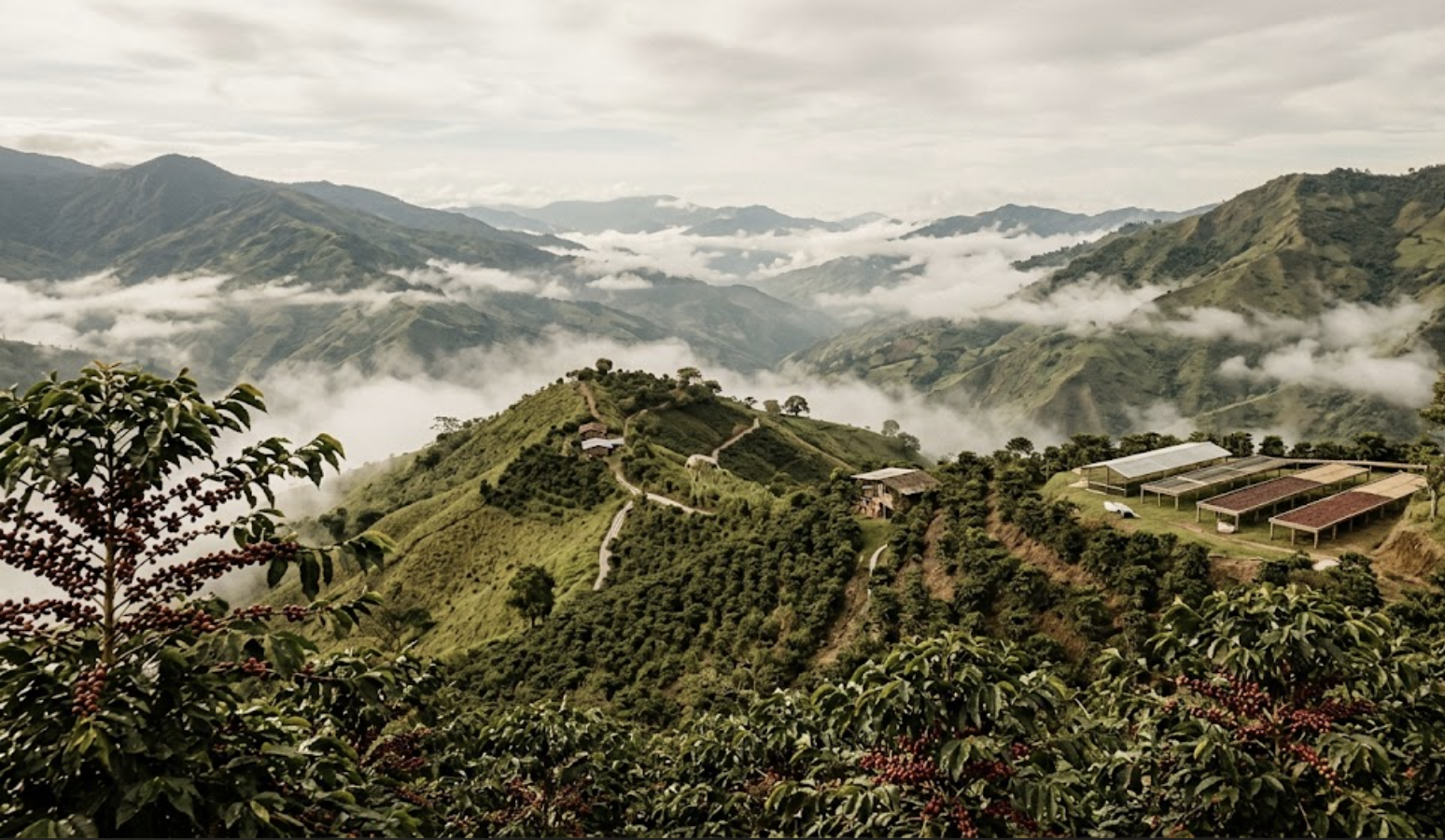
The hillside in late October
In the valley far below — coffee that grew between 1,200 and 1,400 meters — the trees were stripped weeks ago. Up here, the branches still carry green and yellow and the deep, almost-violet red that says now. The pickers move slowly. The cherries ripen slowly. Everything about this elevation is a refusal to hurry.
When we talk about high-altitude coffee — what most of the industry shorthand calls Strictly High-Grown or SHB — we're really talking about time. Time on the tree. Time inside the seed. Time before fermentation, milling, drying, roasting, and the bag of beans that lands on your kitchen counter. Above 1,800 meters, coffee takes longer to do everything. And the longer it takes, the more interesting it becomes in the cup.
This is a quiet guide to what altitude actually does — to the bean, to the acidity, to your brew — and why farms above 1,800 meters command prices that look, at first glance, indefensible. Explore our Colombian origins.
The geography of slowness
A coffee tree is a tropical plant pretending to be temperate. At sea level in equatorial latitudes, Arabica struggles — too hot, too humid, too fast. Climb the slope and the tree relaxes into itself.
For every hundred meters of elevation gain, average temperatures drop by roughly 0.6°C. By the time you cross 1,800 meters, the diurnal swing — the gap between noon warmth and pre-dawn cold — has widened dramatically. Days are bright. Nights are sharp. The tree photosynthesizes during the day and almost stops at night, conserving the sugars it has just made.
This is the engine of high-altitude flavor: sugars accumulate faster than they can be spent.
Down in the valley, a cherry might go from flower to ripe in seven months. At 1,800m and above, the same biological cycle can stretch to nine, ten, sometimes eleven. The cherry hangs longer, takes more sun, more cold, more wind. The seed inside — what you brew — is built differently for it.
Bean density: what "hard" really means
Pick up a green bean from a lot grown at 1,200 meters and one grown at 2,000 meters and they look nearly identical. Drop them on a hard surface and they sound different.
The high-altitude bean is denser. Slow ripening produces a tighter cellular structure, with sugars and acids and aromatic precursors packed into a smaller, harder seed. This is what SHB — Strictly Hard Bean — actually means, and why it appears as a quality grade on Central American coffees and Colombian supremos alike.
A few things follow from that density:
- The roast behaves differently. Dense beans absorb heat more slowly and tolerate longer, more deliberate development. A skilled roaster can pull out caramelization without scorching the surface — something that's much harder with a soft, low-grown bean that risks tipping before its sugars even break.
- Defects are more visible. Because high-grown lots are so consistent, a single sour bean or quaker shows up like a wrong note in a string quartet. Sorting standards at altitude have to be tighter.
- The seed holds its volatiles longer. Aromatics that would dissipate in a porous bean stay locked in for weeks after roasting, which is why a serious high-grown bag from a thoughtful roaster still tastes alive at day 30 in the cupboard.
A useful mental picture: a low-grown bean is a sponge. A high-grown bean is a tightly wound spring.
The acid signature
Acidity is the most misunderstood word in coffee. It does not mean sour. It means brightness — the prickle of citrus, the snap of a green apple, the chime of a ripe stone fruit at the edge of the palate. Acidity is what makes specialty coffee feel three-dimensional instead of flat.
High altitudes are an acidity factory.
The cool nights slow sugar consumption and protect malic, citric, and chlorogenic acids inside the cherry. As the fruit ripens, those acids develop and complex without burning off. By the time the cherry is picked at perfect maturity — deep, glossy red, slightly yielding under the picker's fingers — the green bean inside is carrying a profile something like this:
- Citric acid giving lime, lemon, grapefruit shimmer
- Malic acid giving green apple and stone fruit
- Tartaric notes giving the wine-like quality that tasters call vinous
- A whisper of phosphoric that lifts the cup without souring it
A coffee from below 1,400 meters can be sweet, balanced, comforting — and a great daily cup. But it rarely shows that prismatic acidity. It cannot. The chemistry isn't there.
This is why specialty cuppers chase elevation. A clean acid signature is something altitude gives the bean for free, and no amount of processing virtuosity later can install it after the fact. Learn to taste acidity in your cup.
Why we pay for it
There's a tempting story that altitude alone determines quality. It doesn't. A bean grown at 2,100 meters and harvested carelessly is still a careless coffee. But altitude raises the ceiling on what's possible, and reaching that ceiling is expensive.
Here is what the premium actually pays for:
Labor. Above 1,800 meters the terrain is steep, broken, and unmechanizable. Every cherry is hand-picked, often by the same pickers returning to the same trees five or six times across the harvest window to catch each cluster at peak ripeness. In the valley, a single mechanical pass can strip a whole hillside. Up here, that hillside might see fifty separate visits.
Yield. A high-altitude tree, working slowly, produces less. A productive lowland farm can yield around 2,000 kilograms of green per hectare. A high-altitude microlot might deliver a third of that — sometimes less.
Time. The harvest at altitude can run a month behind the valley's, sometimes two. That's a month of additional risk: rain at the wrong moment, hail, a fungus that prefers cool damp leaves. Every extra day on the tree is a day the farmer is gambling.
Logistics. Roads are worse. Trucks are smaller. A mill might be three hours away over switchbacks. Drying patios sit in thinner air, where moisture leaves the parchment unevenly and the cherry needs constant turning.
Selection. To call a lot "strictly high-grown" and mean it, the farmer sorts by elevation, by varietal, by picking day, by sometimes the exact slope of the parcel. Hundreds of micro-decisions compress into the price per pound.
When you pay more for an SHB or a high-altitude microlot, you're paying for a coffee that was allowed to take its time and then carried — by hand, over distance, through risk — to your cup without that slowness being squandered. Browse our high-altitude microlots.
How to taste it at home
If you've bought a coffee labeled with an elevation above 1,800 meters and you want to actually meet it, three small adjustments will get you there:
- Grind a touch coarser than your default. Dense beans extract more reluctantly. A medium-coarse pour-over grind is a good starting point — finer makes the bright acidity feel sharp rather than alive.
- Drop your brew water to 92–94°C. Hotter water exaggerates bitterness in dense beans and bullies the delicate acids. A small temperature drop opens up the upper register of the cup.
- Taste as it cools. High-altitude coffees are time capsules. They change in the cup over five, ten, fifteen minutes — citrus shifting to dried fruit, then to honey, then to a long sweet finish. The cool-down is half the story.
If the coffee tastes one-dimensional hot and reveals itself as it cools, you've brewed it correctly. That's the altitude talking.
FAQ
- Is higher always better?
- No. Above roughly 2,200 meters, yields drop sharply and the tree can suffer cold damage. The sweet spot for most Arabica varietals sits between 1,600 and 2,000 meters, with the very best lots often coming from 1,800 to 2,000. Beyond that, you're paying for difficulty, not always for the cup.
- What does "SHB" mean on a bag?
- Strictly Hard Bean — a grade indicating the coffee was grown at high enough elevation for the bean to develop a dense, hard cell structure. In Colombia you'll also see Supremo (a size grade that often correlates) and Excelso. None of these guarantee specialty quality on their own, but they signal the conditions that make it possible.
- Can lowland coffee ever taste as bright?
- Specific processing methods — anaerobic fermentation, extended natural drying — can introduce acidity into a lower-grown coffee, but it tends to read as added rather than inherent. The cleanest, most structurally elegant acidity still comes from elevation and slow ripening. There is no real shortcut.
- Why does Colombia produce so much high-altitude coffee?
- The Andes give Colombia an unusually broad band of land between 1,500 and 2,000 meters with the right rainfall and temperature pattern. It's geography more than tradition — though the tradition is now four generations deep.