Single-origin coffee
One farm, one harvest, roasted fresh and traceable all the way back to the slope it grew on.
“Single origin” is printed on a lot of bags now, and the words have gone soft with use. Strictly, they mean the coffee came from one country. That is a low bar. Colombia alone grows coffee across some 20 departments and half a million farms, so “Colombian single origin” tells you about as much as “European wine.”
The version worth paying for narrows all the way down: one region, one farm or a named cluster of farms, one harvest. That is what the label means on a Kyros bag. Here is what it buys you.
What the label promises
A blend is a recipe. A roaster buys coffee from several origins and mixes them to hit a flavor target, and the recipe can change with every purchase without the bag ever saying so. Some blends are very good. None of them can tell you where the coffee grew.
A true single origin does the opposite. It holds still long enough to be checked. You can look up the altitude, ask who grew it, find the cupping score for that lot and, in our case, read the lab certificate for the exact batch in your hands. If something tastes off, there is one farm and one harvest to go back to.
Every Kyros bag names three things: the farm cluster, the altitude band and the harvest. Those are the fields we would need if you asked us to trace the coffee back, so we print them.
Why Tolima
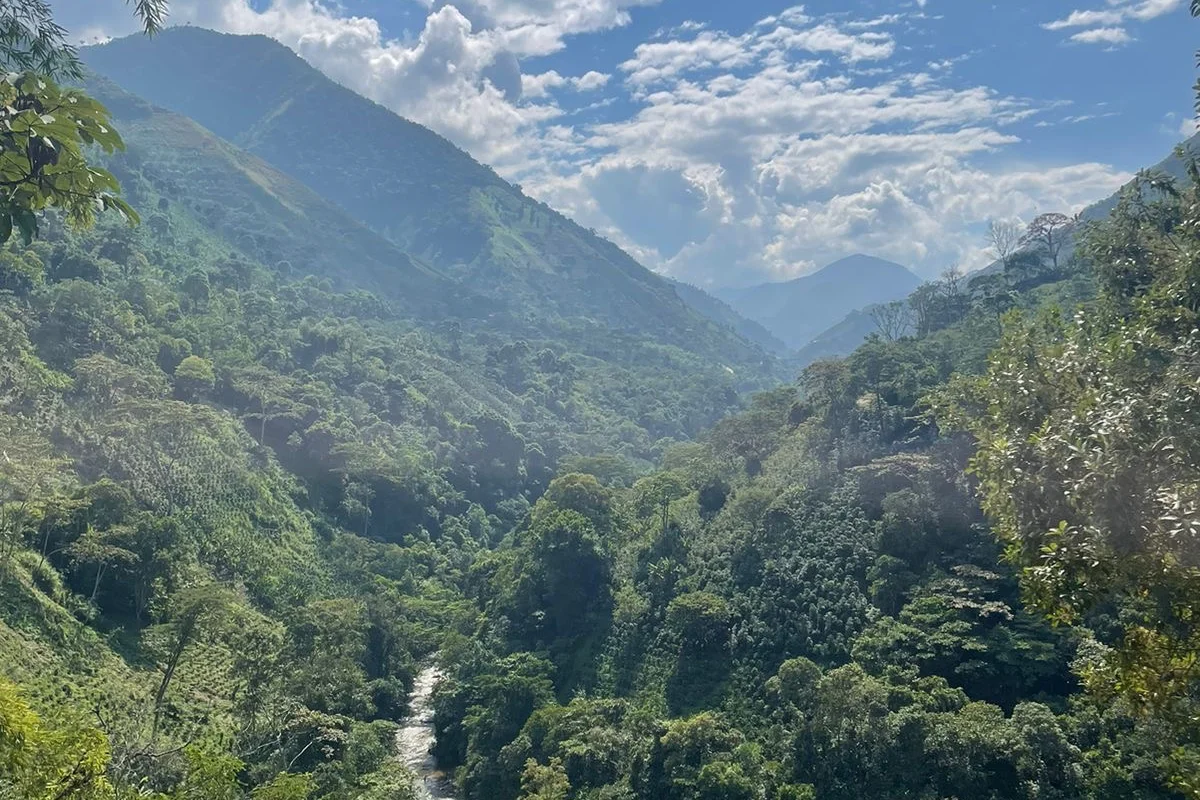
We buy from a cluster of small-holder farms in the Tolima department of Colombia, on the slopes of the Central Cordillera. The farms sit between 1,500 and 2,000 meters on volcanic soil, with warm days, cold nights and the slow ripening that comes with both. We wrote about what altitude does to the bean, so the short version here: slower ripening packs more sugar and acid into a denser seed, and that density is what you taste as brightness and structure.
The honest reason it is Tolima and only Tolima is that we know it. Forest Coffee, our parent operation, has been importing green coffee from this region since 2018 and has direct relationships with the growers. We would rather be very good at one origin than adequate at five. Colombia has a reliable climate for coffee, two harvests a year in many areas, and a grading culture that makes quality easy to verify.
The trees are Castillo, Caturra and Colombia varieties, the workhorses of the Colombian specialty sector. Castillo and Colombia were bred for leaf-rust resistance, Caturra is the older classic, and in Tolima’s conditions all three give a cup that is sweet and clean with citrus and stone fruit up top.
One origin, three coffees
Single origin means a single place, and a place can taste several ways. What happens to the cherry after picking changes the cup as much as where it grew, and our three coffees are the same origin taken down three different roads.
- Washed. The fruit is stripped off before drying, so the bean dries clean. This is the clearest expression of the farm: bright citrus, soft stone fruit, honey, a light-to-medium body. Our Clean & Bright scores SCA 84+ and is the one we point filter drinkers to.
- Natural. The whole cherry dries intact on raised beds, so the bean sits inside the fruit for weeks. Dark berries, dried fruit, brown sugar and a syrupy body. Done badly it turns boozy and inconsistent; done with controlled fermentation it is the most expressive coffee we sell. Rich & Complex scores SCA 86+.
- Sugarcane decaf. The same Tolima coffee, decaffeinated in Colombia with ethyl acetate derived from fermented sugarcane, so the beans never make a round trip to a plant in Europe first. Dark chocolate, caramel, toasted hazelnut. Deep Sleep Decaf is 97 to 99% caffeine-free and still scores 84+ before decaffeination.
Same slope, same growers, three cups you could tell apart blind. That range is what a named origin gives you and a blend hides.
What “specialty” adds on top
Single origin says where the coffee is from. Whether it is any good is a separate question, and for that there is the Specialty Coffee Association scale, a 100-point system where certified Q graders cup the coffee and score it. Anything at 80 or above is specialty grade. Below that is commercial coffee, the kind that ends up in blends and cans.
We never buy below 82, and the coffees we sell score 84+ to 86+. The score is on the bag. If you want the cupping notes behind it, ask and we will send them.
Then there is the part most roasters skip. Every lot we buy is tested by an independent ISO-accredited lab before it is roasted, for ochratoxin A, aflatoxins, lead, cadmium and arsenic. Traceability makes that possible. You can test one farm’s lot and put the result on the bag. You cannot meaningfully test a blend whose recipe changes month to month.
Why it costs more, and where the money goes
Commodity coffee is priced on the C-market, a futures contract that moves with weather in Brazil and speculation in New York and has nothing to do with the cup. Farms selling into it are paid for weight.
We pay about 40% above the C-market price, lot by lot, and we pay it because consistency depends on the grower coming back next harvest with the same care. A farmer who gets a premium for a clean, well-sorted lot will sort the next one just as carefully. A farmer paid by the kilo has no reason to.
Some of the premium also covers what happens above 1,800 meters: hand-picking on slopes no machine can climb, pickers returning to the same trees five or six times across the harvest, lower yields, longer roads to the mill. The About page lays out the numbers.
How to taste the origin
If you have never had a coffee black, a fresh single origin is the one to try it with. Brew it on a paper filter, which shows the cup with the least in the way, and taste it hot, then again 5 minutes later once it has cooled a little. Citrus tends to show first, then the sweetness, then whatever the process added.
Three things make the difference:
- Drink it fresh. The origin character is carried by aromatic compounds that fade over weeks. We roast on Tuesday and ship by Thursday, and the coffee is at its best from day 4 to day 30 after roast. More on that here.
- Filter it. A paper filter clears the oils and fines and lets acidity and sweetness through. Our brewing guide has the V60 and AeroPress recipes we use in the roastery.
- Go easy on the additions. A good single origin is sweet enough that most people find they add less without trying, which lines up with what the health research says about sugar in coffee.
If the coffee tastes like fruit and honey with no sugar in it, you are tasting Tolima. That is the whole promise of the label, and it is the one we can back with a farm name, a score and a lab report on every bag.
Frequently asked questions
- What does single-origin coffee mean?
- Coffee from one place, with the place named. Strictly it means one country, but the label only says something useful when it narrows to a region, a farm and a harvest. Kyros coffee is from a cluster of named farms in Tolima, Colombia, and each bag carries the farm, the altitude and the harvest.
- Is single-origin coffee better than a blend?
- It is more honest, which usually ends up meaning better. A blend can be excellent, but you can't check where it came from or whether the recipe changed. A single origin lets you taste one farm's work and trace it back if something is off.
- Why does single-origin coffee cost more?
- Because it is bought lot by lot, from farms that are paid for quality rather than volume. We pay about 40% above the C-market price so the same growers come back next harvest. Blends buy on price and cover the gaps with roast.
- Should I drink single-origin coffee black?
- Try it black at least once, then drink it however you like. A clean single origin is sweet enough on its own that most people reach for less sugar without meaning to, which is also how the health research says to drink it.
- Does single-origin coffee change from year to year?
- Yes, slightly, and that is the point. Weather shifts the cup a little between harvests. The SCA score, the lab test and the farm stay the same, so what moves is flavor detail. Quality is held constant.